31% Weekly Share Puts Solana Back Atop Tokenized Stock Trading
Key Points
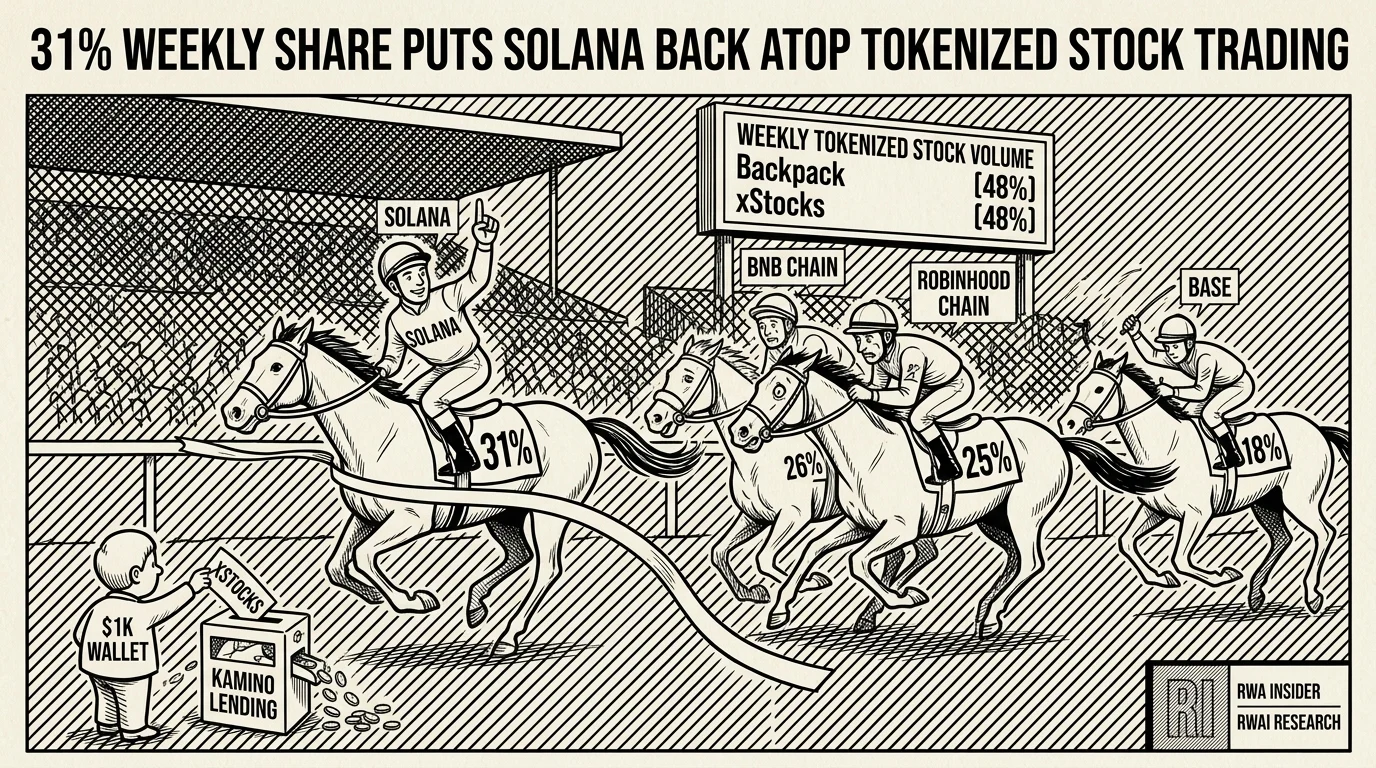
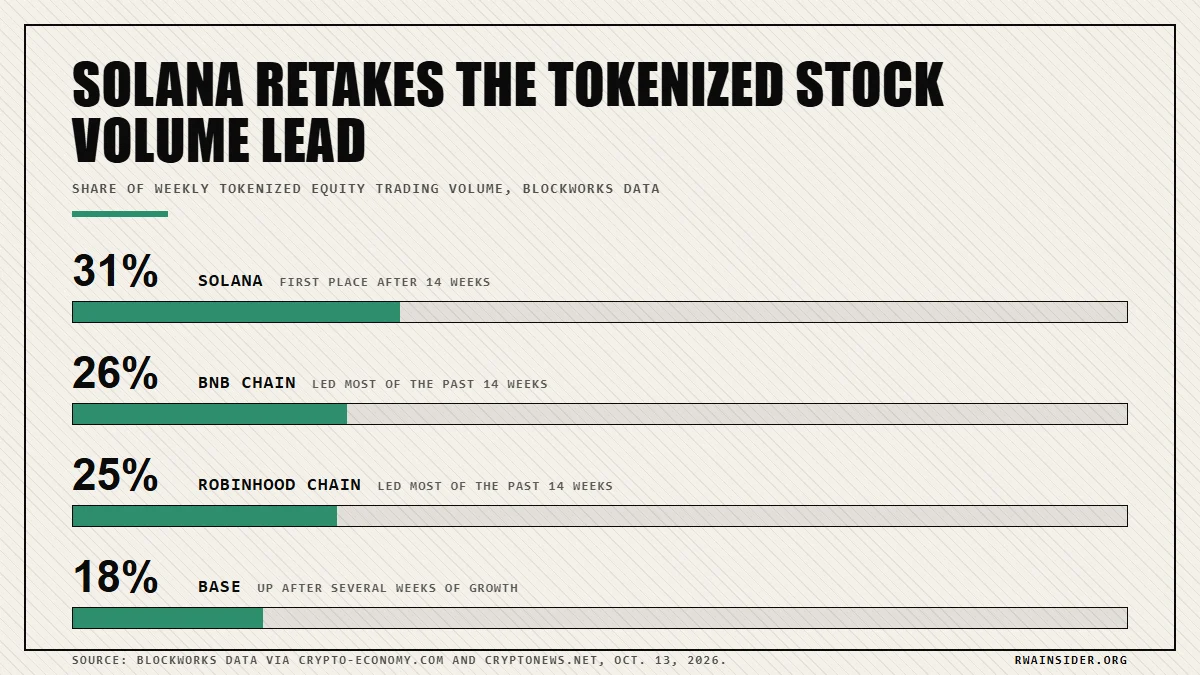
- Blockworks data put Solana at 31% of weekly tokenized equity trading volume, ending a 14-week stretch led by BNB Chain and Robinhood Chain.
- BNB Chain took 26% and Robinhood Chain 25% of the week’s volume, while Base climbed to 18% after several weeks of growth.
- xStocks holds more than 77% of Solana’s tokenized equity supply, and xStocks and Superstate assets already work on Kamino and Jupiter Lend.
Solana is back on top of tokenized stock trading, with 31% of weekly volume across chains, according to Blockworks data. Crypto-economy.com, republished by Cryptonews.net on Oct. 13, reported that Solana “regained the lead in weekly tokenized equity trading volume after 14 weeks.” For your wallet, the detail under the ranking matters more: the issuer that dominates stock token supply on Solana already plugs into lending protocols, so the chain winning volume also has places to borrow against what you buy.
Solana Takes 31% Of Weekly Tokenized Stock Volume
Solana took 31% of weekly tokenized equity trading volume across blockchains, per Blockworks data. It last held the top spot 14 weeks ago.
BNB Chain came second at 26%, with Robinhood Chain close behind at 25%. Those two chains led the market for most of the 14 weeks Solana spent off the top.
Base also gained ground, reaching 18% after several consecutive weeks of growth. It is the only chain the report describes as climbing week after week.
The report ties Solana’s return to a drop in speculative trading, in memecoins and tokenized equities, on other networks. In other words, Solana won partly because rivals cooled.
For a DeFi user, this is a live market, not a pilot. These stock tokens trade on-chain every week, and the share numbers show where the order flow sits right now.
Backpack, xStocks Split 48% Each, But Supply Tells Another Story
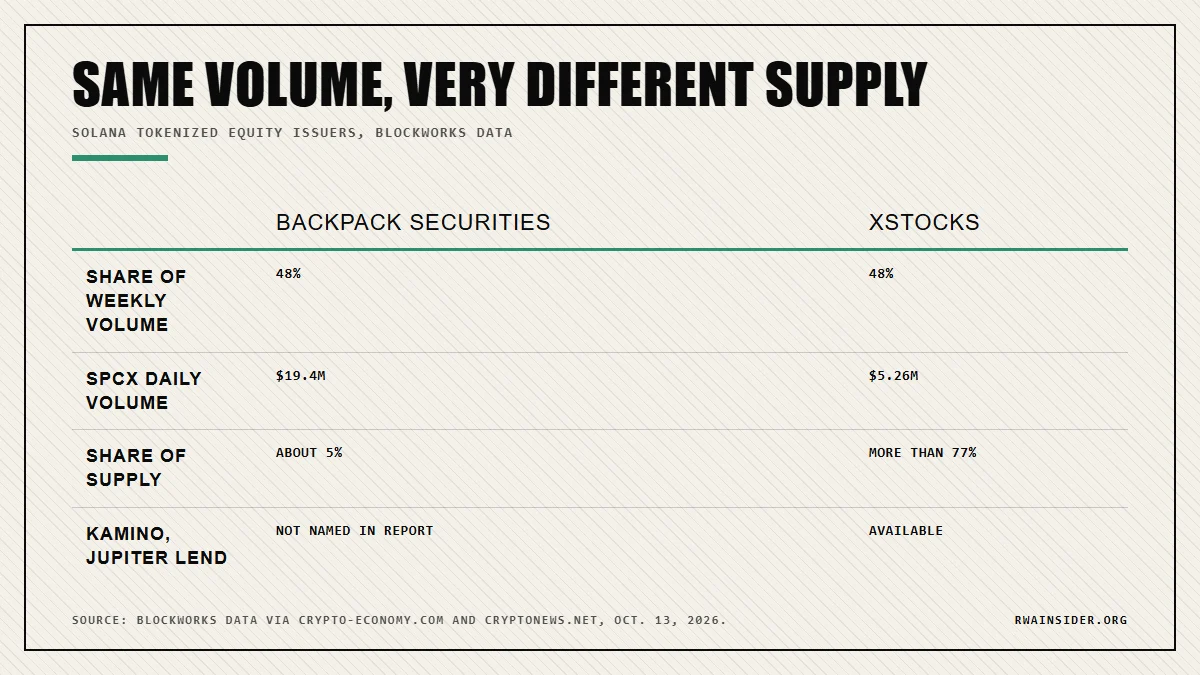
Inside Solana, two issuers fight for the flow. Backpack Securities and xStocks each took 48% of the chain’s tokenized equity volume last week.
Ondo and Securitize recorded smaller shares.
SPCX shows how lopsided single names can get. Backpack’s version traded $19.4 million in daily volume, against $5.26 million for the xStocks version.
Supply flips the picture. xStocks accounts for more than 77% of the tokenized equity supply on Solana, while Backpack Securities holds about 5%, according to Blockworks.
Supply is what you can actually hold and move between apps. Volume only tells you where traders were busy last week.
Strip away the volume race and this is really about which stock token you can put to work after you buy it.
The report says assets issued by xStocks and Superstate are available on lending protocols Kamino and Jupiter Lend, where they can be used in DeFi operations.
It names no Backpack tokens on those protocols. The source also gives no lending rates, so there is no yield comparison to run.
If you are comparing venues before you pick a ticker, you can follow DeFi-native coverage of tokenized stock markets as the share data shifts.
Tokenized Commodities Volume Drops 72% On Solana
Commodities moved the other way. Weekly trading volume for tokenized commodities on Solana fell 72%, from a peak of $92.5 million to about $25 million.
Part of that peak came from memecoins linked to assets such as gold. Custom trading pairs that mixed memecoins with commodities also slowed.
That matters for anyone reading volume as demand. Some of the commodity flow was speculation, and it left quickly.
Rules may cap the equity side too.
In our report on OKXICE’s plan to trade 63 tokenized stocks, Robinhood crypto chief Johann Kerbrat warned that trading could run into the SEC exemption’s caps on eligible symbols and volume.
Robinhood Chain sits right behind Solana at 25%, so that warning applies to the runner-up as much as the leader.
Volume leadership has flipped before. Solana held the top spot, lost it for 14 weeks, and only now took it back.
Watch three things next. Does Solana hold the lead for a second week? Does Backpack’s volume lead turn into more supply? And do Backpack tokens join xStocks on Kamino or Jupiter Lend?
Until then, a $1,000 wallet chasing collateral use has a clearer path through xStocks than through Backpack.
Solana won the week on volume, but xStocks still owns the supply and the lending access. Whether Backpack’s trading lead turns into tokens you can borrow against decides which side of that 48% split your wallet should sit on.
Weighing stock tokens as collateral? The Secondary Markets desk tracks where tokenized equities trade and which pools accept them.
Frequently Asked Questions
Which blockchain trades the most tokenized stocks right now?
Solana led the latest week with 31% of tokenized equity trading volume across chains, per Blockworks data. BNB Chain followed at 26%, Robinhood Chain at 25% and Base at 18%. Solana had spent the previous 14 weeks behind BNB Chain and Robinhood Chain.
What is the difference between Backpack and xStocks tokenized stocks on Solana?
Both are issuers of tokenized equities on Solana, and each took 48% of the chain’s tokenized equity volume last week. xStocks holds more than 77% of the supply, while Backpack Securities holds about 5%. Backpack’s SPCX traded $19.4 million in daily volume against $5.26 million for the xStocks version.
Can I use tokenized stocks as collateral on Solana?
The report says assets issued by xStocks and Superstate are available on Kamino and Jupiter Lend, where they can be used in DeFi operations. It does not name Backpack tokens on those protocols. It also gives no lending rates, so check each market before you borrow.
Why did tokenized commodity trading fall on Solana?
Weekly tokenized commodity volume on Solana dropped 72%, from a $92.5 million peak to about $25 million. Part of the peak came from memecoins linked to assets such as gold. As those markets cooled, custom memecoin and commodity trading pairs slowed too.