$1.34B XRPL Stablecoins Need Little XRP, AMM Pools Hold It
Key Points
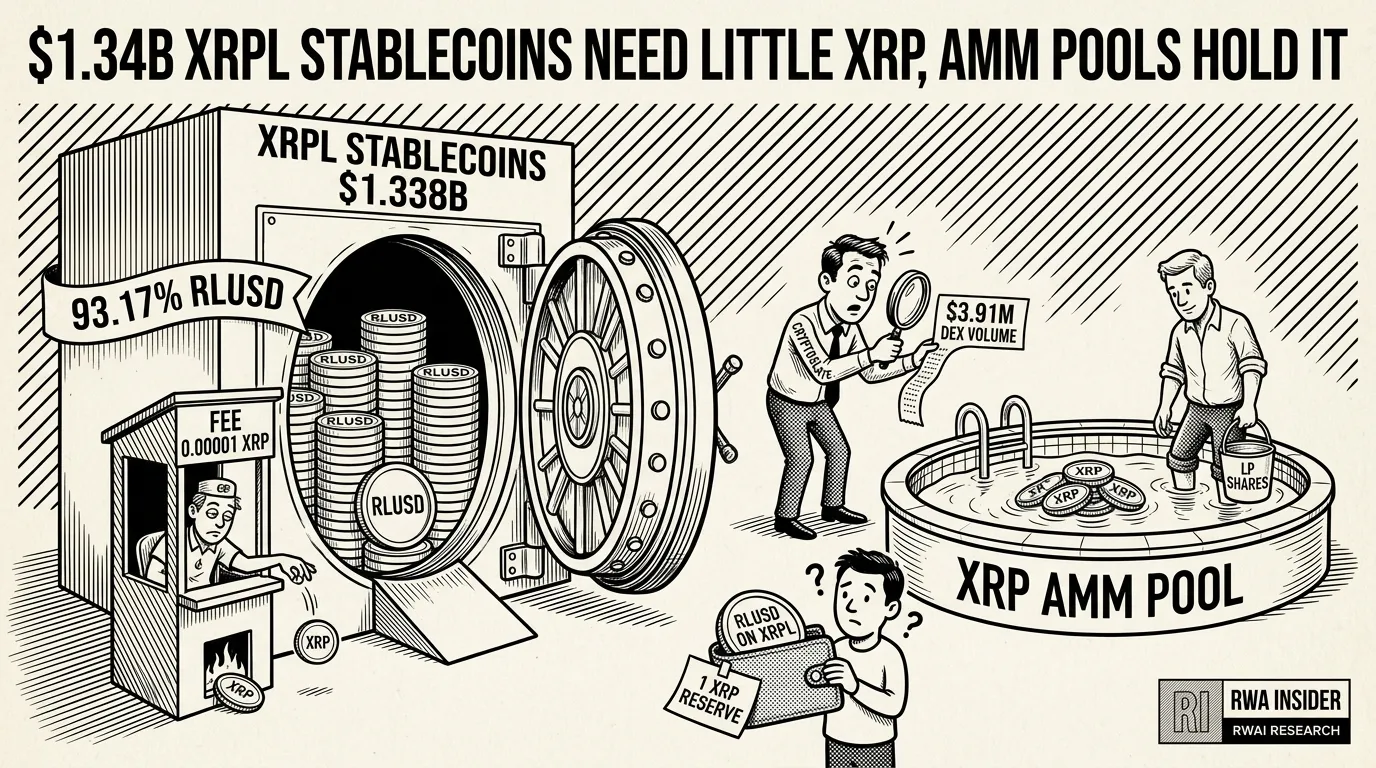
- Tracked stablecoins on the XRP Ledger reached $1.338 billion on October 7, with Ripple’s RLUSD making up 93.17% of the total, per DefiLlama.
- The same DefiLlama snapshot showed only $43.44 million locked in XRPL DeFi, $3.91 million in daily DEX volume and $528 in daily fees.
- A wallet holding RLUSD on XRPL needs a 1 XRP base reserve, while XRP-paired AMM pools are where liquidity providers park real XRP inventory.
Tracked stablecoins on the XRP Ledger hit $1.338 billion on October 7, but that number does not measure how much XRP anyone buys. CryptoSlate Editor-in-Chief Liam Wright broke down the DefiLlama snapshot on October 9, writing that “Stablecoin supply is a balance, trading volume is turnover, and fees are a cost.” For your wallet, the translation is simple: this stablecoin base runs on Ripple’s RLUSD, not XRP, so the XRP story lives in DEX pools and liquidity inventory rather than the headline total.
XRPL’s $1.338B Stablecoin Base Is 93% RLUSD
DefiLlama’s dashboard for the XRP Ledger put tracked stablecoins at $1.338 billion on October 7.
Ripple‘s dollar stablecoin RLUSD made up 93.17% of it. So read the billion-dollar figure as mostly one issuer’s token.
Holding a stablecoin on XRPL does touch XRP, just barely. Each transaction burns a fee of 10 drops, or 0.00001 XRP, before load scaling.
Each account also holds a 1 XRP reserve, and most extra ledger objects add 0.2 XRP. The first two trust lines are exempt on a base-funded account.
Those costs follow your activity, not your balance. Moving a bigger RLUSD balance does not, by itself, raise the XRP fee.
For a wallet with $1,000 in RLUSD, the XRP you need is the reserve plus 10 drops per transfer. The rest of your exposure is to RLUSD and the reserves behind it.
$43.44M In XRPL DeFi Next To $1.338B In Stablecoins
Now set the stablecoin pile next to what actually trades. The same snapshot showed $43.44 million locked in XRPL DeFi.
DEX volume over 24 hours came to $3.91 million, and chain fees for the day totalled $528.
For a ledger holding over a billion dollars in stablecoins, that is a thin daily market.
Wright warns against adding those up. Supply, turnover and fees are different units, and stacking them could count the same assets twice.
Ripple’s issuer-wide numbers add context. Its October 1 transparency report put RLUSD circulation at $2,509.8 million, backed by $2,633.8 million in reserves.
That backing sits in dollars and cash equivalents, and the circulation total spans every chain RLUSD runs on, not XRPL alone.
Strip away the billion-dollar headline and this is really about whether XRP sits in pools long enough to matter, not how many dollars sit on the ledger.
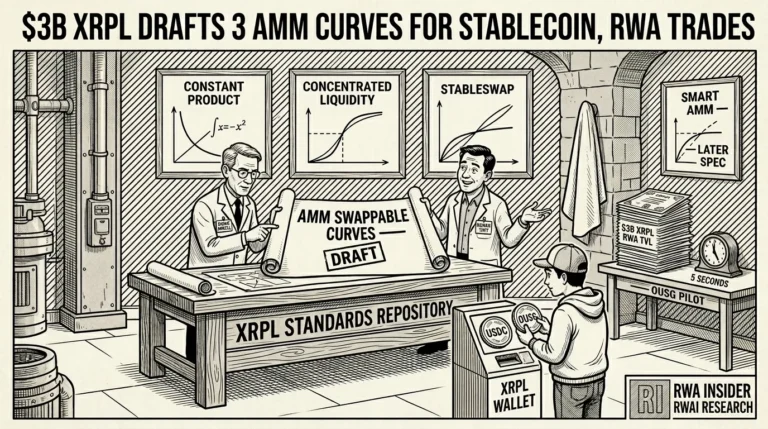
That is where AMM pools come in. XRP-paired pools hold real XRP inventory while it stays deposited, and liquidity providers can redeem their shares.
Pools that pair two issued tokens keep their trading principal in those tokens, outside XRP entirely.
Before you pick a pool, compare liquidity across tokenized asset markets.
Bridge Routes, AMM Pools And Vaults Decide XRP Demand
Wright argues the bigger test is inventory. Auto-bridging can route issued-token trades through XRP when that path is cheaper.
A bridge buys XRP on one leg and sells it on the next. That creates a brief need for XRP, but gross turnover never shows how much XRP intermediaries keep between trades.
“The decisive measurements are the share of activity routed through XRP, the XRP balances committed to liquidity, and how long those balances stay in place,” Wright wrote.
Tokenized funds show the same split. Ondo’s OUSG went live on XRPL in June 2025, with RLUSD handling subscriptions and redemptions.
In Brazil, CSD BR will first mirror BTG Pactual fund-share records on XRPL, with native issuance planned only after that phase is validated.
Lending could change the math. XRPL’s Single Asset Vault design accepts XRP, trust-line tokens or Multi-Purpose Tokens, and an XRP-funded vault commits XRP as loan principal.
Those vaults start with institutions, as our breakdown of XRPL’s planned XRP-backed lending pools showed.
Watch three things: the share of DEX volume routed through XRP, the XRP deposited in AMM pools, and how long it stays there.
Those numbers, not the stablecoin total, show whether XRP liquidity is deepening.
If XRP-paired pools and vaults start holding XRP for months, the stablecoin base turns into real demand. Until a dashboard tracks that, the $1.338 billion figure is a balance, not a buy signal.
Adding XRP liquidity on XRPL? Check the pool’s depth and redemption terms before you deposit.
Frequently Asked Questions
How much stablecoin supply is on the XRP Ledger?
DefiLlama tracked $1.338 billion in stablecoins on XRPL on October 7, 2026. Ripple’s RLUSD made up 93.17% of that total.
Do I need XRP to hold RLUSD on XRPL?
Only a little. Each XRPL account needs a 1 XRP base reserve, and the first two trust lines are exempt on an account funded with just that reserve. Each transaction burns a fee of 10 drops, or 0.00001 XRP, before load scaling.
Where can I trade XRP and RLUSD on XRPL?
XRPL’s decentralized exchange and AMM pools handle issued-token trades, and auto-bridging routes them through XRP when that path is cheaper. DefiLlama showed $3.91 million in 24-hour DEX volume and $43.44 million locked in XRPL DeFi on October 7.
Does stablecoin growth on XRPL create demand for XRP?
Not directly. Stablecoins keep their principal outside XRP, so lasting XRP demand depends on how much activity routes through XRP and how much XRP sits in AMM pools and vaults. The DefiLlama dashboard does not measure either one.