Ripple Files DEX Trademarks, $3T Prime Lands On XRPL
Key Points
- Ripple filed two trademark applications with the USPTO on May 15 covering decentralized exchange and liquidity provider services under its corporate and XRP brands.
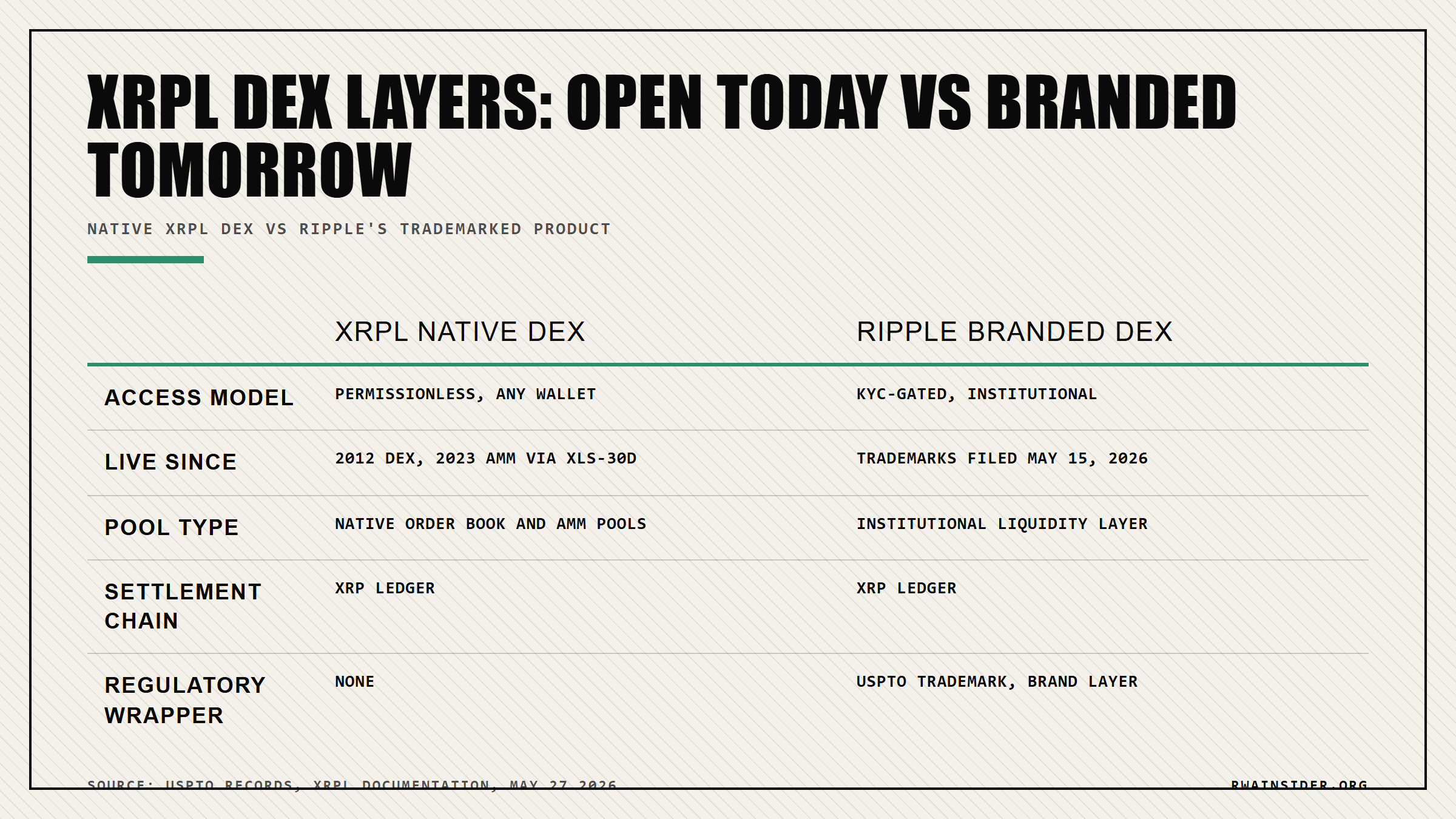
- Ripple Prime, born from the $1.25Bn Hidden Road acquisition, clears over $3 trillion annually for more than 300 institutional clients.
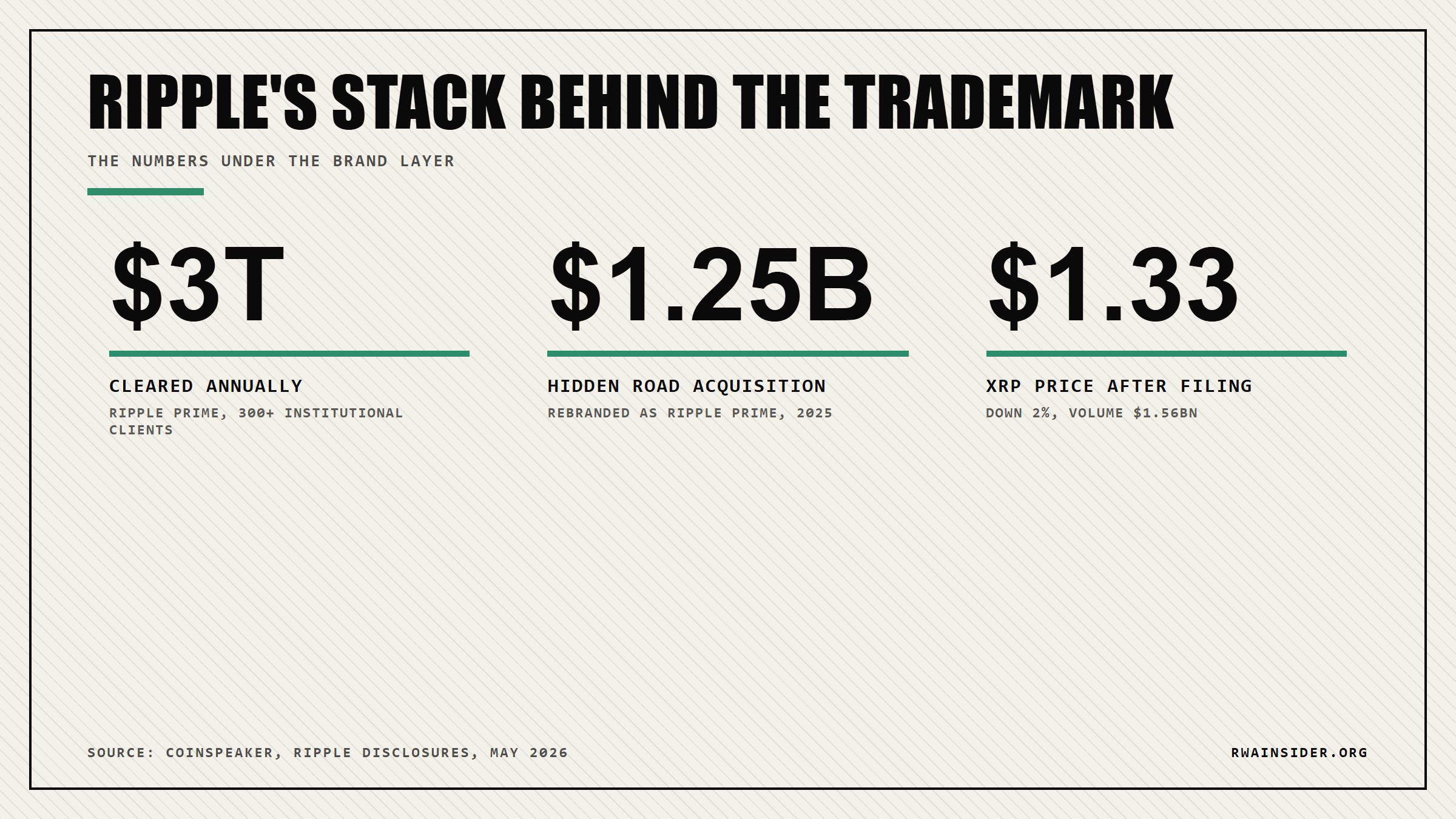
- Any wallet on XRPL can already trade through permissionless AMM pools today; the branded DEX Ripple is signaling will be KYC-gated for institutional flow.
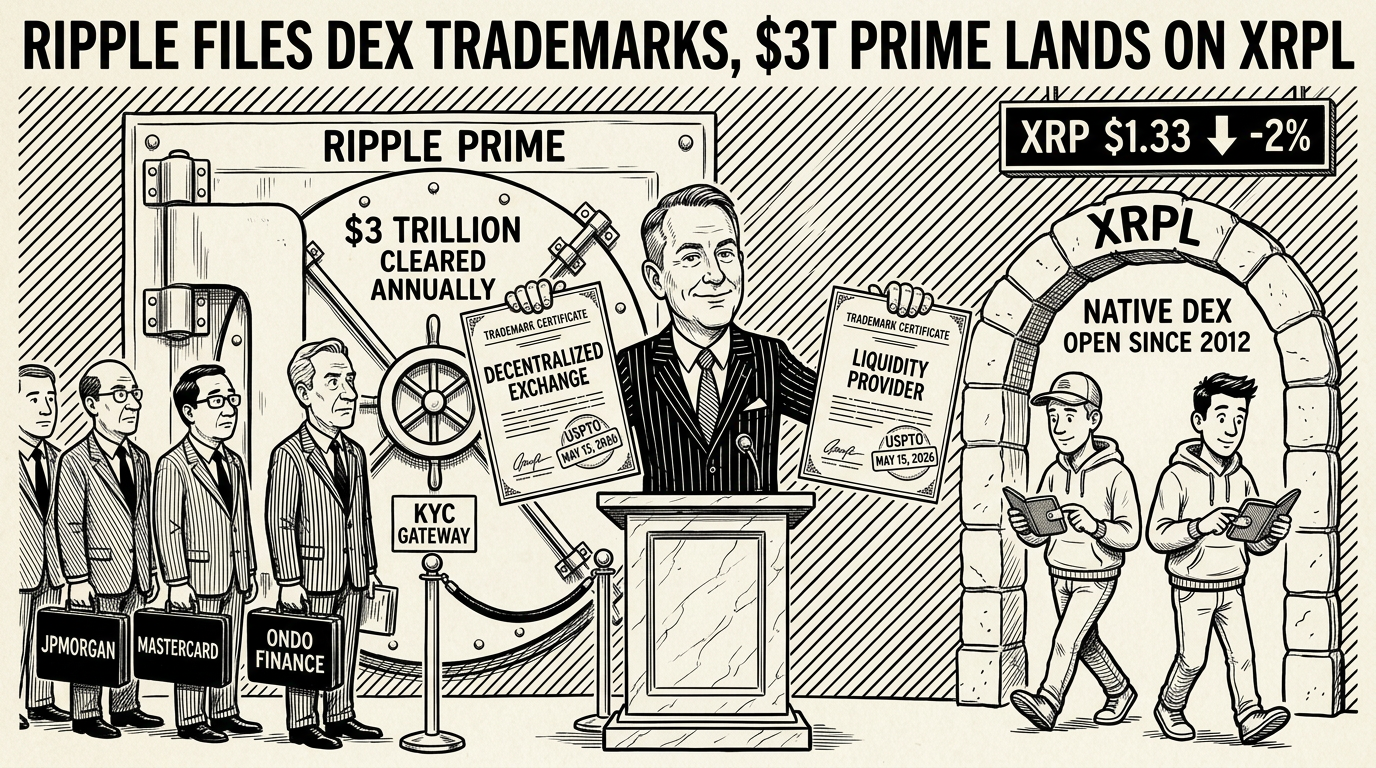
Ripple filed two trademark applications with the U.S. Patent and Trademark Office on May 15 covering “decentralized exchanges and prime brokerage” under its corporate and XRP branding, according to Coinspeaker’s review of USPTO records. The XRP Ledger has run a permissionless DEX since 2012, and the XLS-30d amendment added AMM pools any wallet can route through. Ripple’s filings signal a branded compliant layer sitting on top of that open infrastructure, not a replacement for it, with XRP slipping 2% to $1.33 and 24-hour volume falling to $1.56Bn on the news.
Ripple’s USPTO Filings Land Above XRPL’s Open DEX
The two filings extend Ripple’s brand to cover decentralized trading, AMM operations, and virtual currency liquidity management. They sit on top of infrastructure that is already revenue-generating: custody through Metaco, treasury through GTreasury, stablecoin issuance through RLUSD, and prime brokerage through Ripple Prime.
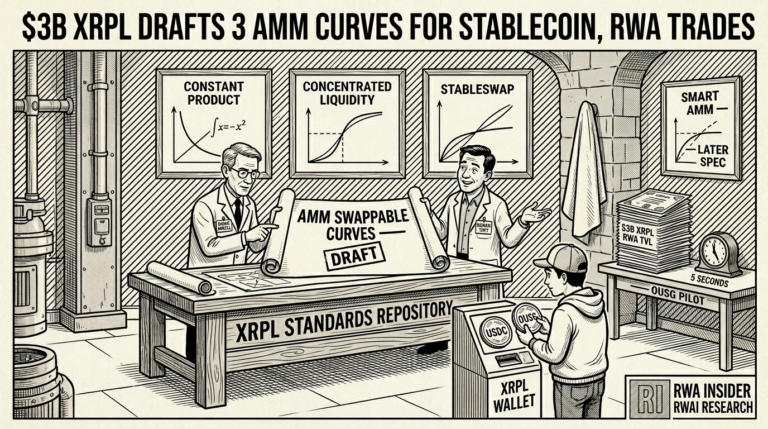
The XRP Ledger itself has carried a native DEX since 2012. After the XLS-30d amendment activated, on-chain AMM pools and liquidity provision became available to any wallet that connects to XRPL.
Ripple CTO David Schwartz has positioned AMM integration as the core lever for XRPL DeFi growth, particularly for institutional flows. The trademark filings give that institutional layer a brand.
$3T Ripple Prime Sits Behind The Branded DEX Layer
Ripple Prime, the rebranded Hidden Road that Ripple acquired in 2025 for $1.25Bn, clears over $3 trillion annually for more than 300 institutional clients. That throughput is what sits behind the new DEX brand.
The Office of the Comptroller of the Currency conditionally approved Ripple’s national trust bank, placing RLUSD reserve management under federal supervision. In May 2026, JPMorgan, Mastercard, and Ondo Finance executed a cross-border redemption of tokenized US Treasuries on the XRP Ledger.
For a DeFi user, this matters less as press-release scale than as plumbing: none of those flows currently touch the permissionless XRPL DEX, and Ripple has not confirmed a launch date for the trademarked product. Trademark filings cover services that may launch later, may fold into existing products like Ripple Prime, or may never ship as standalone interfaces at all.
A wallet with $1k can already swap XRP, RLUSD, and other tokens on XRPL’s native DEX and route through AMM pools without permission. The branded DEX, when it ships, will be KYC-gated.
Permissionless XRPL Pools Versus The Compliant Brand
Coinspeaker’s analysis flags a divergence that matters for token holders: Ripple Prime’s revenue has tripled while XRP itself has fallen from over $2.00 to around $1.33. Ripple is a private company, so prime brokerage revenue accrues to equity holders, not XRP holders.
David Schwartz, Ripple’s CTO, has tied XRPL DeFi growth to AMM integration for institutional use cases. The bullish case for XRP rests on the branded DEX using XRP as a base liquidity pair, generating buy pressure on the token.
The bearish read is the opposite: most institutional volume already runs through RLUSD and fiat rails, leaving XRP with structural relevance but no fresh demand catalyst. Prior coverage of XRPL’s 55% RWA growth showed JMWH driving most of that liquidity, not XRP-paired flows.
Two signals to watch over the next quarter: whether Ripple confirms a product timeline for the trademarked DEX, and whether the existing permissionless XRPL DEX volume tracks the institutional layer or stays separate from it.
Trademarks are not products, and Ripple has yet to confirm a launch date. Whether XRPL ends up with two parallel DEX lanes, one open and one KYC-gated, is what an XRPL wallet’s next year actually depends on.
For more on how each chain is staking out its RWA position, browse RWA Insider’s full secondary markets coverage.
Frequently Asked Questions
What did Ripple file with the USPTO on May 15?
Ripple submitted two trademark applications covering decentralized exchange and liquidity provider services under its corporate and XRP brands. The filings extend Ripple’s brand to AMM operations and virtual currency liquidity management on top of XRP Ledger infrastructure that is already revenue-generating.
Can a wallet trade on XRPL’s DEX without KYC today?
Yes. The XRP Ledger has run a native DEX since 2012, and the XLS-30d amendment added on-chain AMM pools and liquidity provision. Any wallet that connects to XRPL can trade through these existing pools without identity checks. The branded DEX Ripple is trademarking is a separate, institutional layer.
How does Ripple Prime connect to the new DEX trademarks?
Ripple Prime is the rebranded Hidden Road acquisition, which clears over $3 trillion annually for more than 300 institutional clients. The new DEX trademarks sit above that infrastructure, signaling a branded product that would route institutional flow through Ripple’s prime brokerage, custody, and RLUSD rails.
Will the branded XRPL DEX boost XRP token demand?
Not directly. Ripple Prime revenue accrues to equity holders rather than XRP holders, since Ripple is a private company. The bullish case for XRP depends on the branded DEX using XRP as a base liquidity pair. The bearish read is that institutional flow will lean on RLUSD instead, leaving XRP with limited new utility.