
MiCA 2.0 Opens DeFi Licensing, Stablecoin Yield Review
Key Points
- The European Commission opened a public consultation on May 20, 2026 for what regulators call MiCA 2.0, targeting DeFi licensing and stablecoin yield rules.
- MiCA 2.0 will likely require licensing and embedded supervision for DeFi protocols that issue staked tokens, run decentralised lending, or pay yield to holders.
- DeFi users earning stablecoin rewards on Coinbase, Kraken, or exchange platforms should track whether MiCA 2.0 or the GENIUS Act successor reopens yield to retail.
The European Commission opened a public consultation on May 20, 2026 for MiCA 2.0, targeting DeFi licensing and stablecoin yield rules. OMFIF set out the implications at its Digital money summit, where Andrew Forson, CEO of DeFi Technologies, said investors in high-yield DeFi products “should realise that products offering high returns, far outstripping government bond yields, require extensive due diligence.” For wallets earning rewards on exchange-held stablecoins, the question is when these reward structures get reclassified, and whether the US CLARITY Act lands first.
MiCA 2.0 Targets DeFi Protocols For License And Supervision
The European Commission’s May 20 consultation will, in OMFIF’s reading, “likely” make a license requirement and embedded supervision for so-called DeFi markets its most novel component.
MiCA 2.0 addresses regulatory blind spots in the original framework that took effect in June 2023.
The new draft contemplates supervising staking protocols, decentralised lending markets, and yield-bearing token products.
Decentralised financial markets remain small as a share of total crypto markets, OMFIF noted, but their complexity makes them a priority site for regulators.
MiCA 2.0 may also reopen the question of letting stablecoins pay yield. The current MiCA, like the US GENIUS Act, prohibits most stablecoins from paying yield, though asset-referenced tokens may pay yield under conditions.
No asset-referenced tokens have yet been licensed under the original MiCA, the Commission noted, indicating the framework may be too obstructive in its current form.
How GENIUS Act, CLARITY Act, And FCA Rules Reach DeFi Wallets
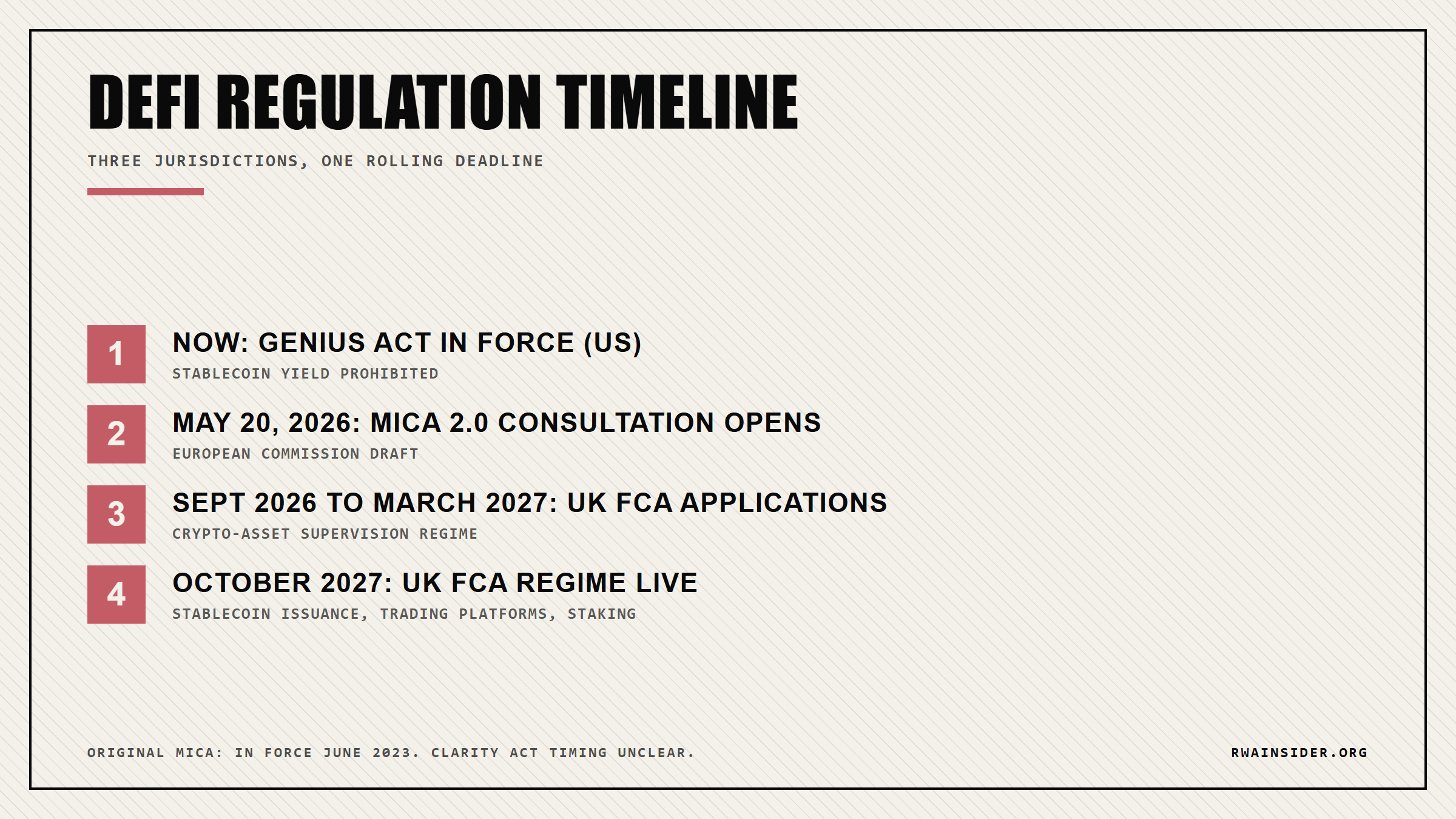
Across the Atlantic, the US GENIUS Act remains the operative stablecoin framework, but a successor bill called CLARITY is still in active debate over market structure rules.
Under the GENIUS Act, stablecoins are barred from paying interest to ensure they don’t compete with bank deposits. Issuers and exchanges currently route around the ban by paying rewards to holders on their platforms.
The CLARITY Act, in its present formulation, would allow rewards for transactions but prohibit passive holding rewards.
That distinction matters for any DeFi user earning yield on Coinbase, Kraken, or wallet-side reward structures.
Strip away the legal language and this is really a contest over whether retail wallets can keep harvesting platform rewards on stablecoin holdings.
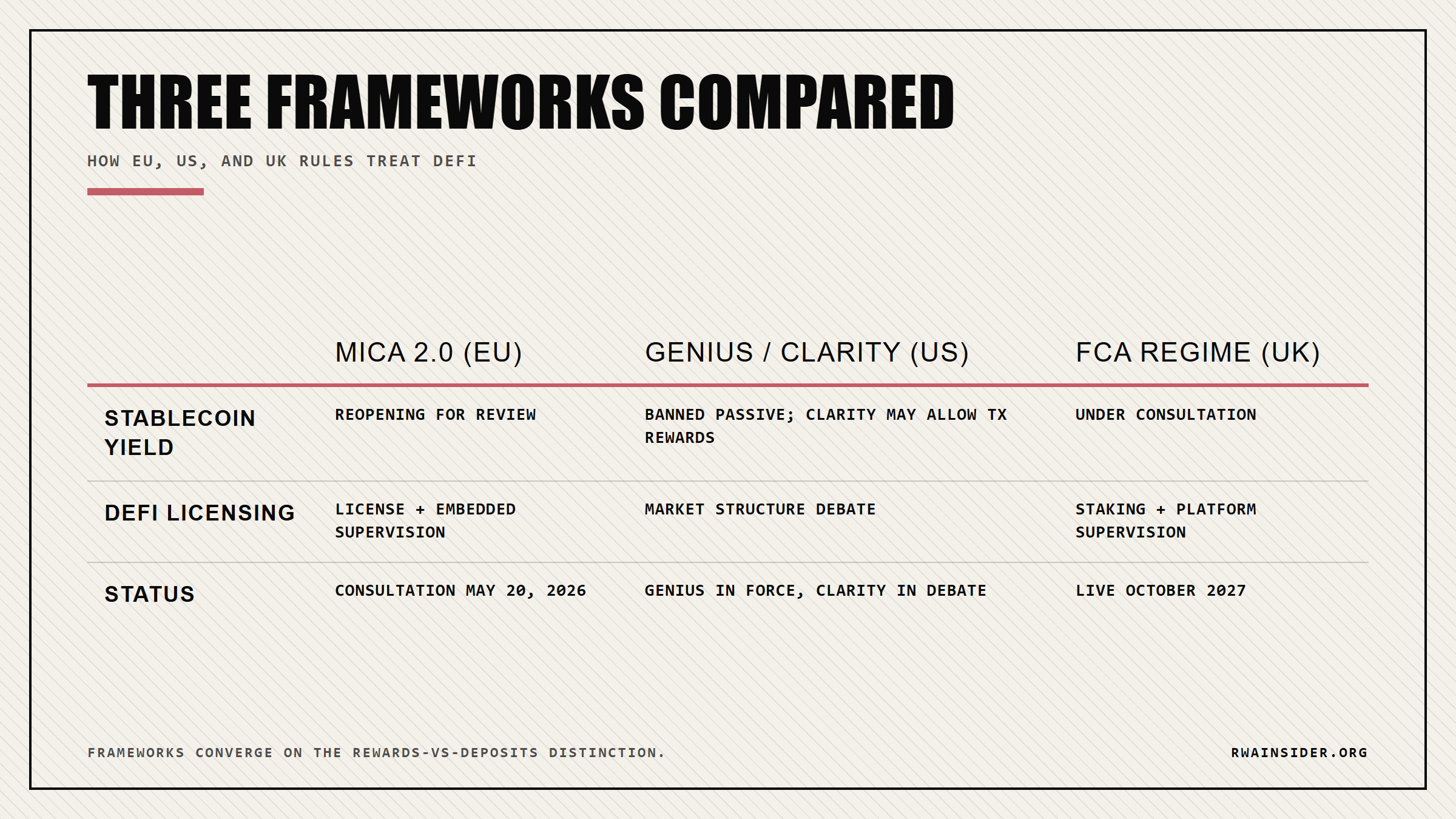
Readers can track regulatory developments across jurisdictions as MiCA 2.0, CLARITY, and the UK FCA regime converge on the same DeFi-rewards question.
The UK Financial Conduct Authority is consulting on its own crypto-asset supervision regime, expected to launch in October 2027.
Applications open between the end of September 2026 and March 2027. Both frameworks may require disclosure standards that DeFi protocols have historically resisted.
What The Massad And Forson Camps See Differently
The summit drew two distinct positions on DeFi-specific risk.
Timothy Massad, the former Commodity Futures Trading Commission chair, pointed at a specific GENIUS Act blind spot, noting “there is only a contractual, rather than a statutory, right to redemption.”
For stablecoin holders, that distinction matters most when an issuer faces stress and a wallet wants its dollars back.
Andrew Forson, CEO of DeFi Technologies, took the buyer-beware stance at the same summit. Investors who fail to do extensive due diligence on high-yield DeFi products “should not be entitled to protection by regulators,” he argued, surfaced via the OMFIF summary.
The two positions frame the regulatory direction. MiCA 2.0, CLARITY, and the FCA regime all converge on the same question: how much of the DeFi yield stack is licensable, and how much remains the user’s own risk.
For wallets actively earning yield, the practical move is to map current reward sources against the upcoming rule changes before the formal license requirements land.
For now, the FCA’s October 2027 launch is the firm deadline on the calendar. MiCA 2.0 and CLARITY remain in consultation phase, with both rounds expected to extend into the second half of 2026 and beyond.
Whether DeFi yield survives MiCA 2.0 and the CLARITY Act in recognisable form depends on whether regulators treat the rewards as banking-like deposits or as protocol-native incentives. The next consultation round will tell.
Track more Safety & Risk coverage from RWA Insider as the licensing wave reaches DeFi.
Frequently Asked Questions
What is MiCA 2.0 and when does it take effect?
MiCA 2.0 is the European Commission’s next revision of the Markets in Crypto-Assets regulation, opened for public consultation on May 20, 2026. It targets DeFi licensing, embedded supervision, and the question of whether stablecoins should be allowed to pay yield. Timing depends on how quickly the consultation moves; the original MiCA took roughly two years from draft to enforcement.
Will MiCA 2.0 ban DeFi yield products?
MiCA 2.0 does not propose an outright ban. The consultation specifically reopens the question of whether stablecoins can pay yield, which the original MiCA prohibits for most types. The most likely outcome is licensing and supervision of yield-bearing protocols rather than a blanket prohibition.
How does the GENIUS Act compare to MiCA 2.0 on stablecoin yield?
The GENIUS Act in the US prohibits stablecoins from paying interest. Its successor CLARITY may permit rewards for transactions but ban passive holding rewards. MiCA 2.0 in Europe is re-examining its own yield prohibition. The three frameworks are converging on the same DeFi rewards question from different angles.
When does the UK FCA crypto regime launch?
The UK Financial Conduct Authority’s crypto-asset supervision regime is expected to launch in October 2027. Applications open between the end of September 2026 and March 2027. Matthew Long, the FCA’s director of payments and digital assets, advised prospective applicants to apply early so the FCA has time to ask follow-up questions.